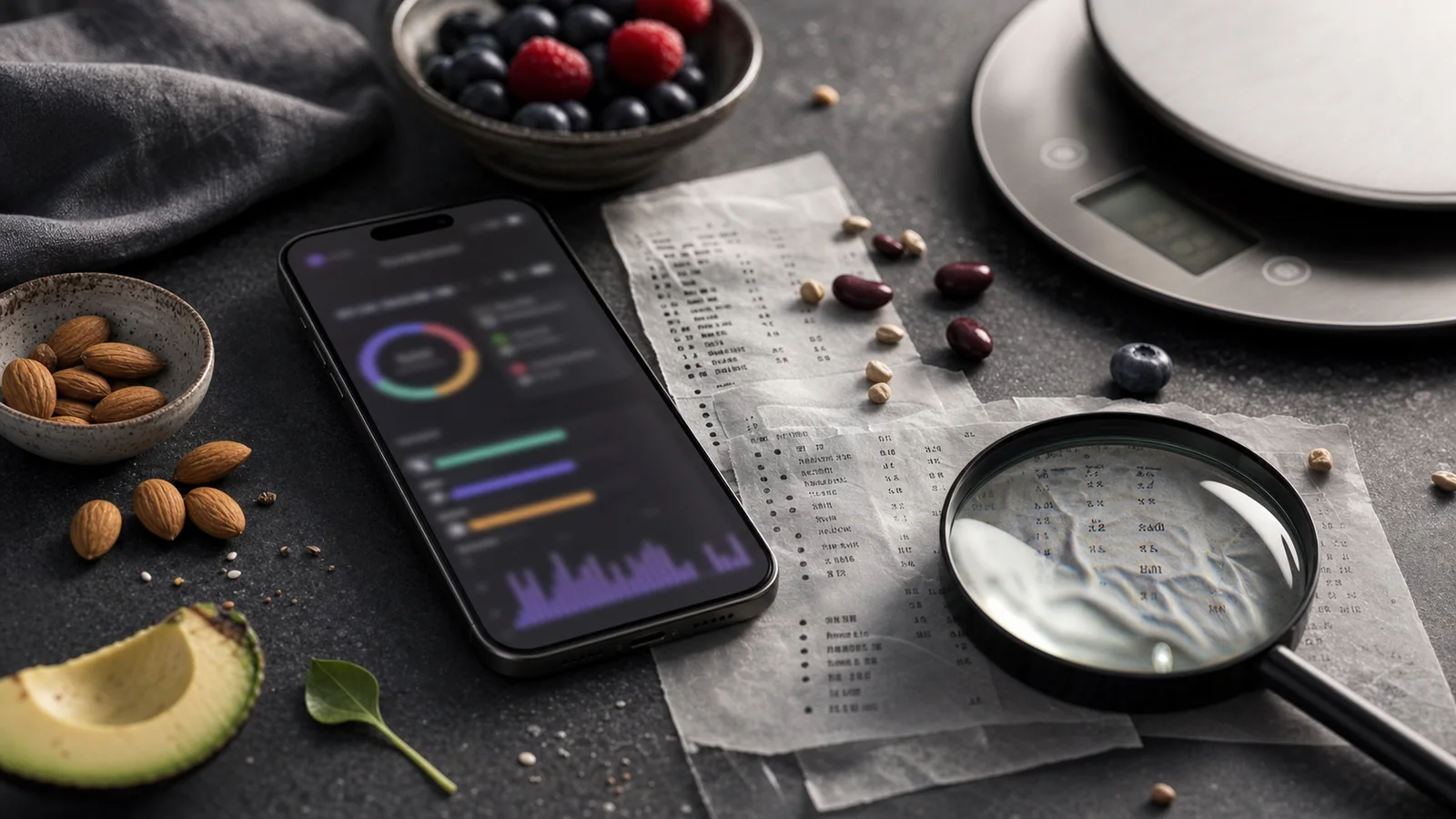
Calories matter, but they are not the plan
Calories are real. Human bodies obey energy balance.
The problem is what happens when an app treats calories as the whole strategy.
A calorie target can describe one constraint: total energy. A macro split can describe another: how that energy is divided across protein, carbohydrates, and fat. Both can be useful. Neither tells you whether the plan is nutrient-dense, filling, well timed, realistic, or adaptable.
That is why simple tracking often disappoints. It asks the user to keep score against a narrow target, then misses the structure that actually makes a nutrition plan work.
The better question is not, “Do calories matter?” They do. The better question is, “Is this plan built well enough that a real person can follow it, recover from imperfect days, and adapt as life changes?”
Macro math misses the quality of the system
A meal can hit its calories and macros and still be a weak meal.
It might be low in fiber. It might be mostly ultra-processed. It might leave the person hungry two hours later. It might fit the numbers but miss iron, calcium, potassium, omega-3 fats, or other nutrients that matter over time. It might be technically “on target” but impossible to repeat during a busy workweek.
That is the central weakness of calorie-first tracking: it measures the easiest thing to reduce to a number, not necessarily the thing that explains adherence, satiety, nutrient coverage, or plan quality.
The Dietary Guidelines describe healthy eating as flexible food patterns that support adequacy, variety, nutrient density, and moderation [9]. That is a very different idea from “stay under the number.”
Nutrition quality is not a bonus detail
This is where calorie and macro tracking becomes too reductionist.
Carbohydrates are not just “carbs.” A refined carbohydrate eaten quickly on its own can produce a very different satiety and glucose response than a slower meal built around intact grains, legumes, vegetables, protein, and fat. Higher-quality carbohydrate patterns, especially those rich in fiber and whole grains, are associated with better health outcomes in systematic reviews [11]. Fiber also changes what happens inside the meal: viscous and fermentable fibers can slow digestion, reduce the glycemic impact of carbohydrate, and feed gut microbes that produce short-chain fatty acids [12].
Fat is not just “fat” either. The same macro line can hide very different food quality. Extra-virgin olive oil, nuts, avocado, seeds, and fatty fish bring unsaturated fats and food matrices that behave differently from a diet pattern dominated by refined starches and industrial fats. Cardiovascular nutrition guidance has long distinguished unsaturated fat quality from saturated and trans fat exposure, because fat type affects lipid biology and broader cardiovascular risk markers [13].
Protein is more than a protein target. Amino acids support tissue repair, enzymes, transport proteins, immune function, and the maintenance of lean mass. Micronutrients matter for the same reason: B vitamins, magnesium, iron, zinc, iodine, selenium, and other nutrients act as cofactors or structural inputs for metabolic processes that keep the system running [14]. A tracker can show a meal that fits 600 calories and 40 grams of carbohydrate. It cannot assume that meal supports the user’s metabolism well unless it also understands food quality, fiber, fat quality, protein distribution, micronutrient coverage, and the rest of the day.
Same calories, different plan quality
Two meals can have similar calories and macro splits but behave differently in practice.
Food environment matters too. In an inpatient randomized controlled trial, participants ate substantially more during an ultra-processed diet phase than during an unprocessed diet phase, even though the offered diets were matched for presented calories, sugar, fat, fiber, and macronutrients [7].
Food structure matters too. In controlled feeding research, whole almonds delivered less metabolizable energy than Atwater-based estimates predicted [2]. Processing changed that picture: almond butter and more disrupted almond forms made more energy available than intact whole almonds [3].
That does not mean calories are irrelevant. It means the system around the calories matters: texture, processing, protein, fiber, eating speed, palatability, fullness, and follow-up hunger.
Take two 600-calorie lunches:
- a pastry, sweetened coffee, and a small snack,
- or a bowl with salmon, lentils, vegetables, olive oil, and berries.
Both can fit the same calorie target. But they do not offer the same protein distribution, fiber, micronutrient coverage, satiety, blood-sugar stability, or usefulness for the next meal decision.
That is where an adaptive system can help. Instead of asking only “Did this fit the calorie budget?”, a better system asks:
- Did this meal support the plan structure?
- Did it move protein, fiber, and nutrient quality in the right direction?
- Did it fit the user’s meal timing and routine?
- Is the likely next action obvious and realistic?
Tracking should create feedback, not judgment
Classic trackers turn meals into a pass/fail ledger. That can create awareness, but it does not necessarily create better decisions.
A useful adaptive system should treat each log as feedback for the plan:
- If breakfast is always low in protein, update breakfast defaults.
- If weekends break the plan, create weekend-specific meal structure.
- If dinners are high quality but too small, adjust satiety and snack guidance.
- If sleep and activity change, adapt timing and meal composition rather than just changing a calorie number.
In nubi, Meal Diary is designed to be more than a place where meals are judged in isolation. It is part of a feedback loop that helps My Plan, Meal Plan, and chat guidance become more useful.
Biology changes the plan over time
Another reason static calorie tracking fails is that the user’s body and life do not stay static.
When weight, activity, sleep, appetite, and routine change, the same target can stop fitting. Energy expenditure estimates also contain meaningful uncertainty. Resting metabolic rate equations can be wrong for individuals [10], and activity monitors vary in how well they estimate energy expenditure [4].
Adaptive thermogenesis is one reason the same calorie target may not behave the same way over time [6]. One well-known follow-up study of participants from “The Biggest Loser” found persistent metabolic adaptation six years after major weight loss [5]. That was an extreme intervention, so it should not be treated as a normal dieting template. But it illustrates the broader point: long-term planning needs adaptation, not just arithmetic.
An adaptive nutrition system should ask, “What changed?” before it says, “Try harder.”
Accuracy issues are another reason calories should be context
Simple tracking also has a precision problem.
Packaged food labels are allowed to contain normal variation under U.S. labeling rules [1]. Portions are often guessed. Restaurant meals rarely match database entries exactly. Oils, sauces, and cooking methods can be invisible. Wearable calorie-burn estimates should be treated as rough context, not exact compensation [4].
That is not the main reason calorie-only tracking falls short, but it reinforces the same conclusion. Calories are useful context. They should not be treated as commands from a perfectly measured system.
Tracking can become psychologically expensive
For some people, logging food is neutral. For others, it creates a constant sense of surveillance.
That matters. Research in people with eating disorders has found that calorie-tracking apps can be perceived as contributing to eating-disorder symptoms for some users [8]. This does not mean every tracker causes harm, and it does not mean food awareness is bad. It means rigid number-focused tracking is not a low-risk tool for everyone.
Warning signs include:
- guilt or panic when a number is exceeded,
- avoiding social meals because they are hard to log,
- reducing food variety to make tracking easier,
- ignoring hunger or fullness because the app says otherwise,
- and feeling unable to eat without permission from a number.
If tracking creates those patterns, the cost is too high. A healthier adaptive system should make food feedback feel informative, not like permission to eat or proof that the user failed.
What adaptive nutrition does differently
A better nutrition plan can still use calorie awareness, but it should not depend on calorie awareness alone.
The stronger system is structured around:
- energy as one constraint,
- protein and macro distribution as another,
- fiber, fat quality, added sugar, sodium, and micronutrient coverage,
- meal timing and routine fit,
- food preferences and sustainability,
- wearable context where it is useful,
- and meal feedback that changes the plan over time.
In nubi, calories are context. They are not the whole conversation.
That means a logged meal should help answer a bigger question: how well did this meal support the plan, and what should change next?
General wellness scope
This article provides general wellness and nutrition education only. It is not medical advice and is not intended to diagnose, treat, cure, or prevent disease. If you have a medical condition, take medication that affects appetite or blood glucose, are pregnant, have abnormal labs, or have a history of disordered eating, work with a qualified clinician before making major nutrition changes.