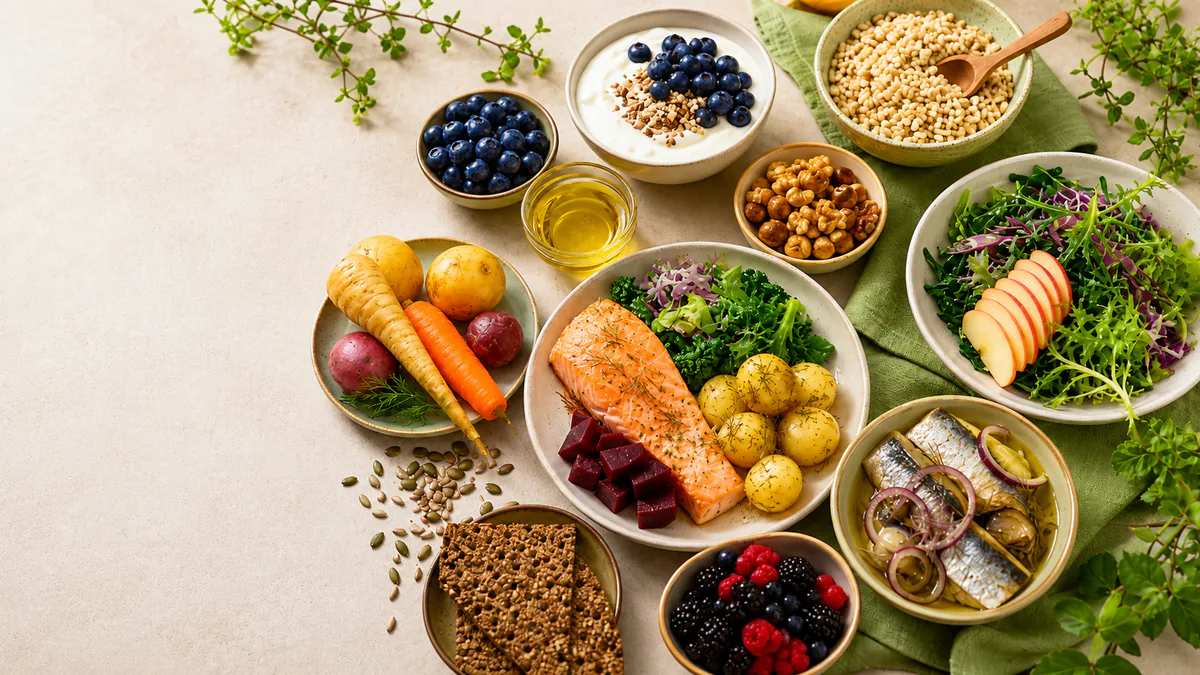
What people mean by a Nordic diet
The Nordic diet is less a rigid rule book and more a regional whole-food pattern.
Its common themes are:
- root vegetables, cabbages, and leafy greens,
- berries, apples, and pears,
- whole grains like oats, rye, and barley,
- legumes and peas,
- fish,
- nuts and seeds,
- and unsaturated fats such as rapeseed oil or olive oil.
It also tends to push down heavily processed foods, sugary drinks, pastries, and red or processed meat.
Why people are interested in it
The Nordic pattern appeals to people who want a balanced and practical default rather than a more extreme diet identity.
Its main strengths are:
- staple foods that feel familiar and realistic,
- high fiber from grains, berries, vegetables, and legumes,
- better fat quality through fish, nuts, seeds, and unsaturated oils,
- and a structure that can work well for everyday meals instead of only ideal days.
That is also why the pattern lines up closely with the Nordic Nutrition Recommendations, which emphasize a mostly plant-forward pattern with berries, whole grains, fish, legumes, nuts, and lower intake of processed foods, salt, sugar, and saturated fat [1].
What the science says about why Nordic eating is considered beneficial
The Nordic diet gets attention because it is not only a nice-sounding idea. Reviews of the research have linked healthy Nordic-style eating with better cardiometabolic outcomes [2].
Randomized studies add to that picture. In one six-month trial, a healthy Nordic pattern improved several health markers in adults with increased waist circumference [3]. In another trial, a healthy Nordic pattern lowered ambulatory diastolic blood pressure and mean arterial pressure in adults with features of metabolic syndrome [4].
That does not mean the results are automatic. It does help explain why the pattern is often considered beneficial:
- it emphasizes fiber-rich whole foods,
- it improves fat quality by leaning toward fish and unsaturated oils,
- and it replaces a lot of the foods that tend to drive excess salt, sugar, and low-quality fats.
How the standard nubi Nordic plan is structured
In nubi, the standard Nordic template is built on the platform’s default backend targets and then expressed through a Nordic-style eating pattern.
The current standard template uses:
- roughly 52.5% carbohydrate, 15% protein, and 32.5% fat,
- strong emphasis on fiber, monounsaturated fats, and overall food quality,
- priority foods such as root vegetables, cabbages, leafy greens, berries, oats, rye, barley, legumes, peas, fatty fish, low-fat cultured dairy, and nuts or seeds,
- and a lower role for processed and high-sodium convenience foods, sugary drinks and sweets, refined grains and pastries, red and processed meats, butter-heavy choices, and deep-fried foods.
The template also puts special weight on micronutrients and food quality areas that fit the pattern well, including vitamin D, vitamin C, folate, magnesium, and potassium.
Who this plan may fit best
This pattern often makes sense for people who:
- want a balanced, non-extreme nutrition baseline,
- like whole grains, berries, fish, and seasonal vegetables,
- want a plan that feels broadly healthy without a complicated rule set,
- and prefer something easier to repeat than very low-carb or heavily exclusion-based approaches.
It can work especially well when the real goal is better daily eating quality and consistency rather than a dramatic diet reset.
Tradeoffs to be honest about
The Nordic pattern is practical, but it still has some friction points.
Common ones include:
- people hear “healthy Nordic” and still default to too many refined baked foods,
- fish, berries, and quality whole grains can feel expensive if the plan is not simplified,
- and some people may not naturally enjoy low-fat cultured dairy or legume-heavy meals.
A useful plan needs realistic defaults, not just good principles.
A simple first-week version
For most people, a strong first week looks like:
- oats or rye as one dependable grain base,
- berries and fruit as easy defaults instead of sweets,
- one or two fish meals,
- vegetables anchored into lunch and dinner,
- and one backup meal built around whole grains, legumes, and vegetables for busy days.
You do not need to redesign your whole kitchen to make the pattern meaningful.
How this fits the nubi product
In nubi, the standard Nordic plan is meant to be a practical starting point you can actually use.
That means:
- activate the standard plan in the Marketplace,
- review the food emphasis and targets in My Plan,
- generate matching meals in Meal Plan,
- and refine the plan in chat when your preferences, schedule, appetite, or goals change.
The useful part is not only the Nordic label. It is how quickly the app can turn the pattern into repeatable meals that fit your normal week.
General wellness scope
This article provides general wellness and nutrition guidance only. It is not medical advice and is not intended to diagnose, treat, cure, or prevent disease. If you need disease-specific nutrition treatment or medication-related guidance, work with a qualified clinician.