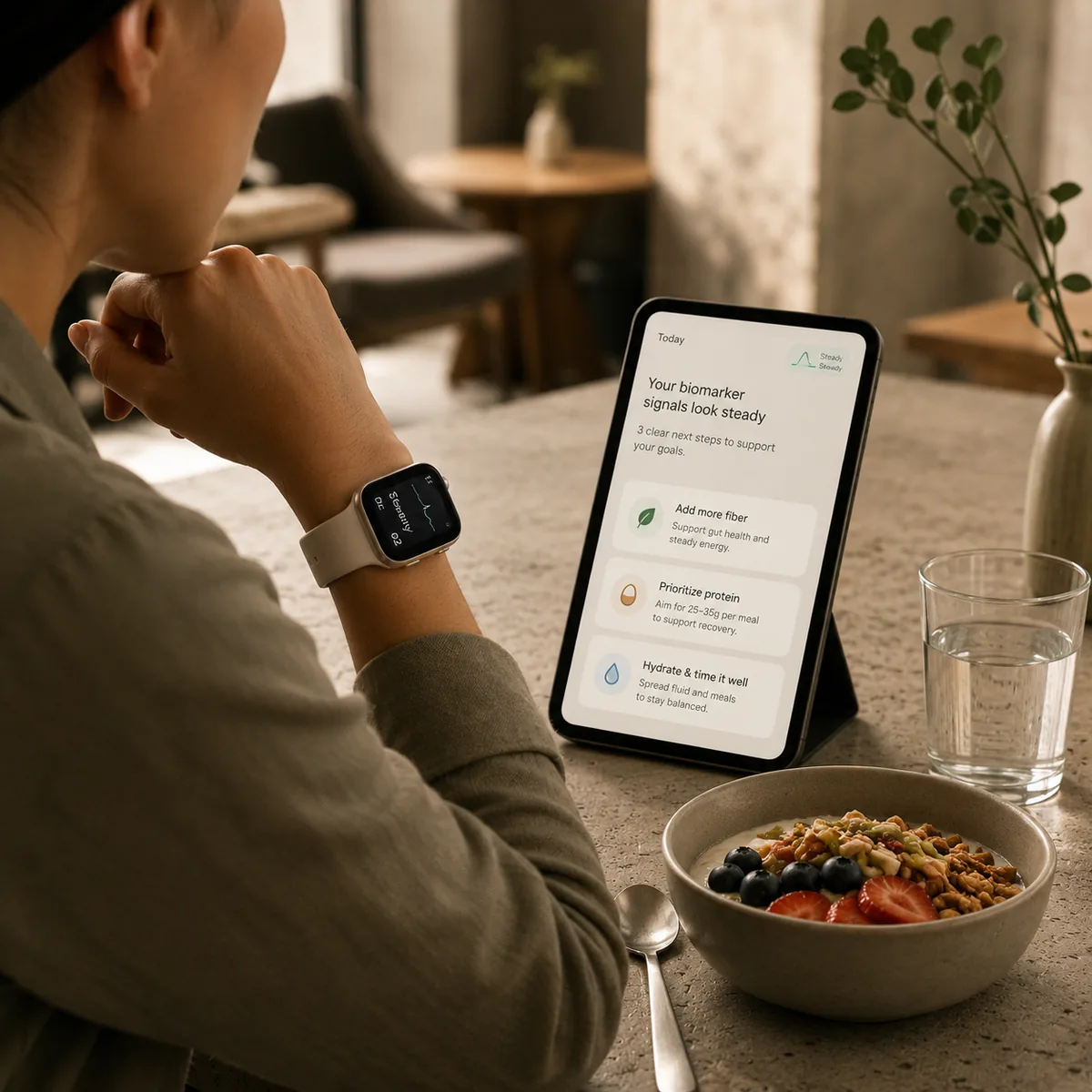
What consumers should actually care about
Most people do not need a lecture on specific biomarkers. They want to know something simpler:
- can this help me understand what to focus on,
- can it reduce guesswork,
- and can it turn health data into realistic nutrition decisions?
That is the real consumer promise of biomarkers. The future is not just more tests. It is better use of signals so nutrition guidance becomes more personal, more timely, and easier to act on.
A simple way to think about different biomarker types
When people talk about biomarkers, they may be talking about very different kinds of signals.
For consumers, a simple mental model is:
- Dynamic measurements: signals that can change throughout the day or week, such as continuous glucose monitoring (CGMs) and emerging continuous insulin or cortisol measurements.
- Traditional lab markers: more established measurements such as lipid markers, A1C, or other routine blood-based indicators that help with a longer-term baseline.
- Composite health scores: summarized scores that try to reflect the state of a body system or function, such as metabolic, cardiovascular, liver, recovery, or broader organ-health style scores.
- Genetics and epigenetics: slower-changing layers that may help explain predispositions or long-term patterns, but usually do not give precise meal-by-meal instructions on their own.
These categories are not equally mature, not equally validated, and not equally useful for day-to-day nutrition decisions. That is one reason the product experience matters so much: the system has to translate very different types of signals into guidance that is still understandable and practical. The future of biomarkers is making these signals integrated and combined into actionable steps for users.
Why the old biomarker model feels limited
Traditional lab tests are useful, but they are usually occasional snapshots.
That means they can help with big-picture questions like:
- is my overall direction improving,
- is there a possible issue worth checking with a clinician,
- and what higher-level nutrition objective may deserve more attention?
What they usually do not do well is explain everyday variation. A lab result from one point in time cannot fully reflect a stressful week, inconsistent sleep, recent training changes, or what happened over the last few meals.
What the future should feel like for the consumer
As biomarker products improve, the experience should become less technical from the user point of view, not more.
For consumers, that should mean:
- more context instead of isolated numbers,
- better timing instead of generic advice,
- and clearer priorities instead of long dashboards full of metrics.
In practice, the future of biomarkers is likely to combine multiple types of information:
- periodic lab-based signals,
- more dynamic context from daily life,
- and smarter interpretation that connects those signals to your nutrition plan.
The important part is not the technology itself. The important part is whether it helps you answer: “What should I work on next?”
How biomarkers can inform better nutrition priorities
For most people, biomarkers are most useful when they inform high-level objectives rather than hyper-specific food rules.
That can look like:
- putting more emphasis on overall diet quality,
- increasing attention to meal consistency and structure,
- prioritizing protein, iron, or B12 adequacy in the right context,
- supporting cardiometabolic health more intentionally,
- or recognizing that recovery, sleep, and training context should affect how demanding the plan should feel.
That is a much more realistic consumer use case than expecting biomarkers to dictate the exact right breakfast, lunch, and dinner every day.
What a bad biomarker experience looks like
Consumers should be careful about products that turn every new signal into pressure.
Warning signs include:
- too many metrics without a clear purpose,
- dramatic recommendations based on a single reading,
- claims that a device or test can tell you exactly what to eat,
- and interfaces that make you feel like you are constantly failing a hidden scorecard.
More biomarker data does not automatically mean better nutrition management. In many cases, it just creates more noise.
What a good biomarker experience should do
Better biomarker experiences tend to share four properties:
- Explainable: you can see the “because…” behind a recommendation.
- Conservative by default: avoids dramatic changes based on one reading.
- Integrated: connects signals across domains rather than optimizing one metric in isolation.
- Actionable: produces one or two next steps you can actually execute.
For consumers, this should feel like less confusion, not more. A good biomarker-aware nutrition product should help you understand your priorities and adjust your plan without turning nutrition into a full-time monitoring job.
What this means in nubi
At nubi, we see the future biomarker layer as a way to make nutrition planning more useful, not more complicated.
In upcoming releases, we will offer partner biomarker services that can integrate directly into your nutrition plan. The goal is not to overwhelm you with more numbers. The goal is to help the app understand your situation better and use that context to shape clearer nutrition priorities, more relevant plan updates, and better recommendations.
If you want to see how nubi thinks about current and future integrations, start at Integrations and How it works.