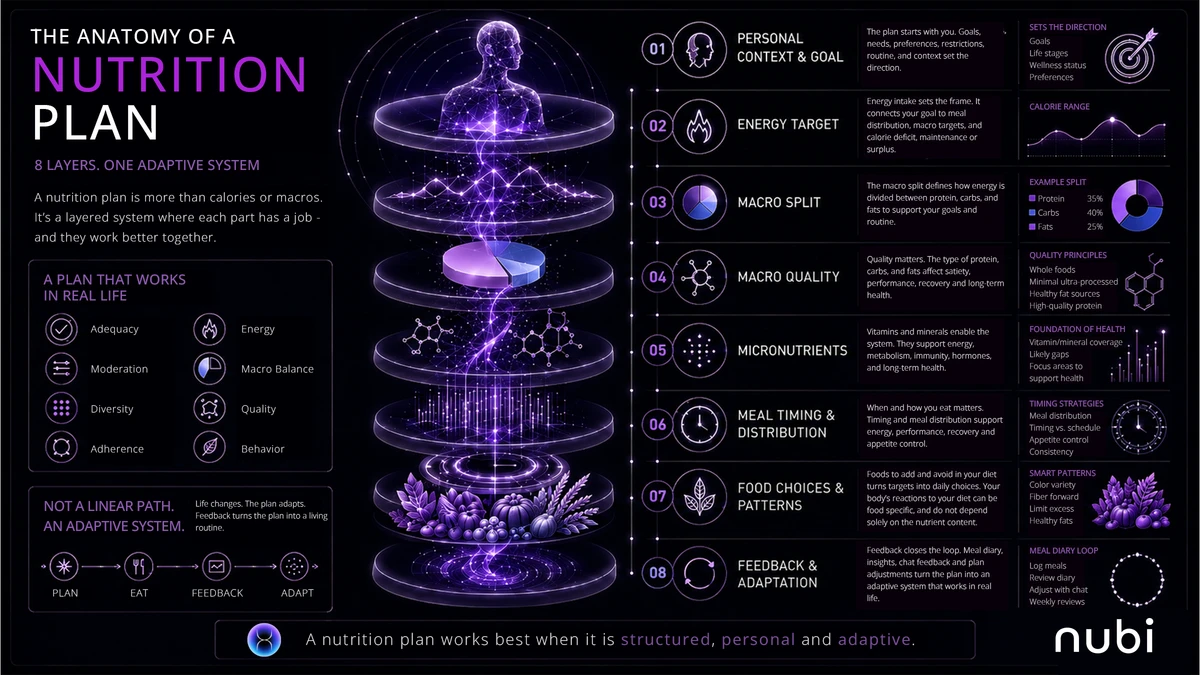
A plan is a structure, not a slogan
A diet label can be useful shorthand. Mediterranean, ketogenic, high-protein, plant-forward, low-carb, and balanced all tell you something about the direction of a plan.
But a label does not prove the plan is complete.
A scientific nutrition plan has to answer more questions. What is the goal? How much energy does the person need? What macro pattern fits the goal and routine? Are the foods nutrient-dense? Are micronutrients covered? Can the person actually eat this way during normal weeks? What happens when the plan meets real meals?
That is why nubi treats a nutrition plan as a layered system. Each layer has a job, and the plan gets stronger when those layers work together.
Layer 1: personal context and goal
The first layer is not food. It is the person.
A useful plan starts with goal, needs, preferences, restrictions, routine, and current context. A plan for maintenance should not behave like a plan for muscle gain. A plan for a person who cooks most nights should not behave like a plan for someone who travels every week. A plan that ignores allergies, budget, appetite, culture, and schedule may be technically neat but practically weak.
This is also where nutrition science needs humility. People can respond differently to the same foods and patterns. Personalized nutrition research has shown meaningful person-to-person variation in post-meal glucose, triglyceride, and insulin responses [5][6]. That does not mean every person needs a complicated biomarker protocol before choosing lunch. It means the plan should have enough structure to be evidence-informed and enough flexibility to adapt when real life says something important.
In nubi, this personal context gives the plan its direction before targets are interpreted.
Layer 2: energy target
Energy intake is the frame of the plan. It helps connect the goal to the size of the diet.
For some goals, energy balance is the main lever. For others, it is a guardrail. A person may want more stable energy, better meal quality, better training support, or a more consistent routine. Even then, the plan still needs a reasonable energy target so the rest of the structure has scale.
The mistake is treating calories as the whole plan. Energy matters, but it does not tell you whether protein is adequate, whether fiber is high enough, whether fat quality is strong, whether sodium is excessive, or whether the person has any realistic meals to eat.
In nubi, energy intake sits near the top of the structure because it informs portions, meal distribution, and macro targets. It is important, but it is not asked to do every job.
Layer 3: macro split
The macro split describes how energy is distributed across protein, carbohydrates, and fat.
This is where many plans start, but it should not be where they stop. A macro split can support different diet styles: higher-carbohydrate, lower-carbohydrate, higher-protein, Mediterranean-style, ketogenic, or balanced. The right split depends on the goal, activity, preferences, and constraints.
The National Academies Dietary Reference Intakes provide broad macronutrient ranges for healthy diets, which helps show why multiple patterns can be reasonable when structured well [3]. The World Health Organization also frames healthy diets around adequacy, balance, moderation, and diversity rather than one universal macro formula [1].
In nubi, macro split is a practical layer. It gives the plan shape, but it still needs quality checks underneath.
Layer 4: macro quality
Two meals can share the same macros and have very different nutrition quality.
That is why a plan needs a macro quality layer:
- Protein quality: Does the plan provide enough protein from useful sources, and does it support the person’s needs?
- Carbohydrate quality: Are carbohydrates coming mostly from higher-fiber foods such as vegetables, fruit, legumes, and whole grains where the plan allows?
- Fat quality: Does the plan emphasize unsaturated fats and keep saturated and trans fats in check?
Protein is a good example. For active people and people doing resistance training, higher protein can support training adaptations. A large meta-analysis found that protein supplementation increased resistance-training gains in strength and fat-free mass, with benefits leveling off around 1.6 grams per kilogram per day for fat-free mass gains [4]. That does not mean every person needs the same protein target. It means the plan should interpret protein in context rather than treating it as a vague “eat more protein” rule.
Carbohydrate quality matters too. The WHO highlights whole grains, vegetables, fruits, and pulses as core carbohydrate sources in a healthy diet, with attention to fiber and free sugars [1]. Fat quality matters because the same fat percentage can come from very different sources. A plan built around olive oil, nuts, seeds, avocado, and fish is not the same as one built around mostly fried foods and processed meats.
Macro quality protects the plan from being technically correct and nutritionally shallow.
Layer 5: micronutrients
Micronutrients are the quiet layer. They are easy to miss because they do not dominate food marketing the way calories and protein do.
But vitamins and minerals matter for a complete plan. The Dietary Guidelines for Americans emphasize nutrient-dense foods across food groups within calorie limits [2]. The WHO similarly describes diverse diets as a way to improve the likelihood of meeting vitamin and mineral needs [1].
In practice, micronutrient planning means looking for likely gaps. A plant-exclusive pattern needs attention to vitamin B12 and other nutrients. A very low-carbohydrate pattern may need stronger planning around fiber, vegetables, magnesium, potassium, and food variety. A low-dairy pattern may need attention to calcium and vitamin D sources. A highly repetitive diet may look controlled while quietly narrowing nutrient coverage.
In nubi, micronutrients are not a decorative appendix. They help make sure the plan is not only goal-directed, but also balanced.
Layer 6: meal timing
Meal timing turns a daily plan into a day people can actually follow.
Timing does not need to become rigid. For most general wellness plans, the exact clock time is less important than having a pattern that supports hunger, energy, training, sleep, work, and consistency. A person who skips breakfast comfortably may need a different structure than someone who gets too hungry by midday. A person training after work may need dinner and snack timing to make sense.
In nubi, meal timing helps distribute the plan across breakfast, lunch, dinner, and snacks. That makes the plan easier to translate into meal suggestions and easier to compare against actual meal logs.
Layer 7: food choices
Food choices are where science becomes shopping, cooking, ordering, and eating.
A plan should say what to emphasize and what to limit in plain food language. That might include vegetables, legumes, whole grains, berries, nuts, fish, fermented foods, lean proteins, olive oil, or other foods that match the plan style. It may also include foods to limit, such as frequent sugary drinks, heavily processed snacks, processed meats, or high-sodium defaults.
This layer matters because people do not eat macro percentages. They eat meals. The best target in the world is not useful if the person cannot see what to put on the plate.
In nubi, food choices connect the plan to Meal Plan and Meal Diary. The plan can guide meal generation, and logged meals can be assessed against the food emphasis in the plan.
Layer 8: feedback and adaptation
The final layer is what keeps the plan alive.
A static plan assumes the first version was right enough forever. Real nutrition rarely works that way. Schedule changes. Sleep changes. Activity changes. Appetite changes. Preferences change. A plan can also reveal its weak points only after someone tries to follow it.
That is why feedback matters. The useful question is not only, “Did this meal hit the numbers?” It is also:
- Did the meal fit the plan direction?
- Did it support today’s needs?
- Was it realistic enough to repeat?
- What small adjustment would improve tomorrow?
In nubi, Meal Diary helps compare actual meals against the plan, while chat-based adjustment helps refine the plan when the current version stops fitting. Over time, this creates a loop: set the plan, eat real meals, review the pattern, and adjust the structure without losing the science underneath.
How the layers work together
The anatomy of a nutrition plan is not a checklist where each item sits alone. The layers should influence each other.
Energy affects macro grams. Macro split affects meal structure. Macro quality affects food choices. Micronutrient needs affect which foods should appear more often. Meal timing affects adherence. Feedback shows where the plan needs to change.
This is why a balanced scientific plan is not the same as a stricter plan. In many cases, the stronger plan is the one that creates enough structure to guide decisions while leaving enough flexibility to survive normal weeks.
For nubi, that is the point of the plan anatomy. The plan should be understandable, adjustable, and practical. It should help you know what matters most without turning every meal into a spreadsheet.
General wellness scope
This article provides general wellness and nutrition guidance only. It is not medical advice and is not intended to diagnose, treat, cure, or prevent disease. If you need disease-specific nutrition guidance, medication-related guidance, pregnancy support, or help with a history of disordered eating, work with a qualified clinician.